Quantum Duality as a Game Engine
⚛️ Quantum Duality as a Game Engine
Physics often feels abstract, but sometimes the best way to explain it is through everyday analogies. One of my favorites is comparing quantum duality to how computer games render graphics.
The Double-Slit Experiment
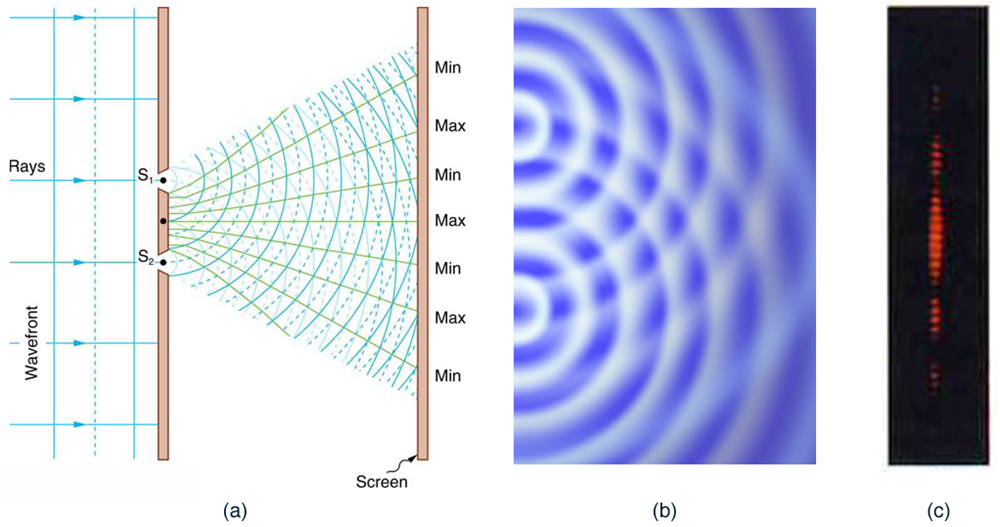 In the classic double-slit experiment, particles like photons or electrons behave like waves when not observed, creating interference patterns. But when we measure which slit they go through, they behave like particles instead.
The Game Rendering Analogy
Think about how a computer game works:
- The game engine doesn’t render the entire world at once.
- It only renders the part of the world visible on your screen.
- This saves resources and makes the system efficient.
Now apply this to quantum mechanics:
- The universe doesn’t “render” every particle as a definite object all the time.
- Instead, everything exists in a wave-like state until observed.
- Observation is like looking at the screen: the wave collapses into a particle.
Why Waves First?
Waves represent the lowest-energy, most efficient state. Just like a game engine avoids wasting resources, nature avoids unnecessary energy use. Only when observation demands it does the wave collapse into a particle.
A Cosmic Game
This analogy suggests the universe operates like a vast simulation:
- Waves are the background code, efficient and invisible.
- Particles are the rendered graphics, appearing only when needed.
It’s not proof of simulation theory, but it’s a powerful way to visualize quantum duality. Instead of thinking of physics as cold equations, we can see it as a dynamic, resource-efficient system—like the ultimate game engine.
Philosophical Reflections
The idea of quantum duality as a game engine resonates deeply with enduring philosophical questions about the nature of reality and perception.
Plato’s Allegory of the Cave
Plato’s allegory depicts people confined to a cave, perceiving only shadows cast on a wall and mistaking these illusions for reality itself. In a similar vein, quantum particles present different “shadows”—wave-like or particle-like behaviors—depending on how we observe them. This suggests that our perception fundamentally shapes the reality we experience, much like the prisoners mistaking shadows for the whole truth.
Kant’s Phenomena and Noumena
Immanuel Kant distinguished between phenomena (the world as we perceive it) and noumena (things as they are in themselves, beyond our perception). Quantum duality mirrors this distinction: the wave state represents the noumenal potential, an underlying reality not directly accessible, while the particle state is the phenomenal manifestation that arises upon observation. This philosophical lens highlights the limits of human knowledge and the role of observation in shaping what we can know.
Phenomenalism and Constructed Reality
Philosophers such as Berkeley and later phenomenalists argue that reality is constructed through perception. The game engine analogy aligns with this view, portraying the universe as a system where observation “renders” reality dynamically. This perspective blends physics with epistemology, emphasizing how knowledge and existence are intertwined, and how reality may be as much about information and observation as about physical substance.
These philosophical reflections enrich the analogy, revealing that quantum duality is not merely a physical phenomenon but also a profound insight into how knowledge, perception, and existence are deeply interconnected, inviting ongoing exploration across disciplines.